What a leased line does and does not secure.
Have you ever found yourself worrying about the security of your internet connection, especially with all the stories about cyberattacks? You’re not alone. As businesses increasingly rely on digital connectivity, the security of our online interactions becomes more crucial than ever. One question that keeps popping up is: How secure are leased lines?
The Basics: What Exactly Is a Leased Line?
Imagine you’ve got a private lane on a busy motorway, reserved just for you. No traffic, no congestion, and most importantly, no one else can use it. That’s essentially what a leased line is. It’s a dedicated, private connection between your business and the internet. Unlike the typical broadband connection that you might use at home, which is shared with other users, a leased line is exclusively for your business. This exclusivity brings with it a host of security benefits.

Why Security Matters More Than Ever
We live in an age where cyber threats are not just a possibility but a daily reality. Businesses are prime targets, and a single security breach can lead to significant losses. This is why understanding the security advantages of leased lines is so critical.
Where leased lines can improve security and control
1. Dedicated capacity and greater control
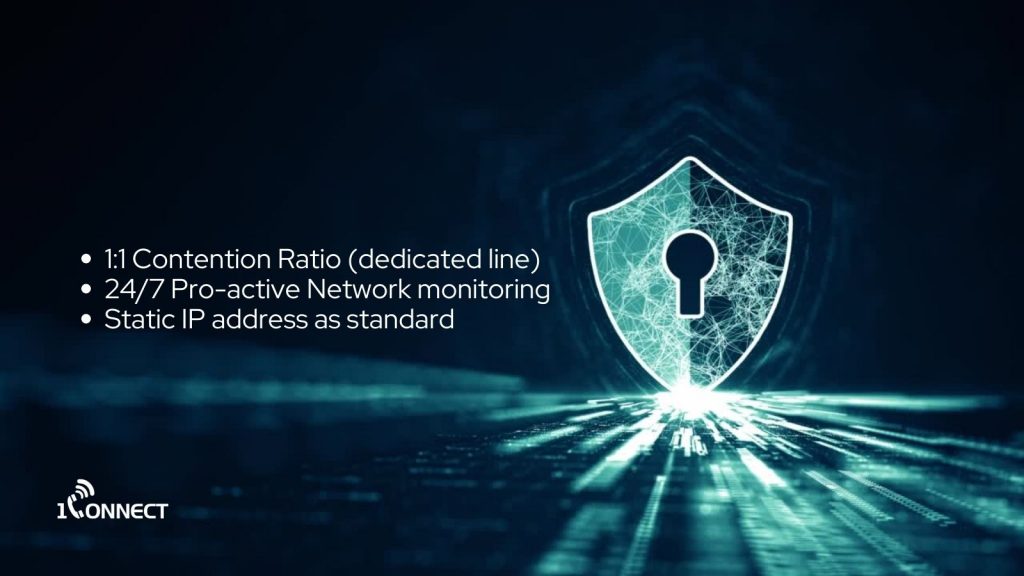
A leased line provides dedicated capacity between your premises and the provider’s network, rather than sharing local access capacity in the same way as standard broadband. This gives your business more consistent performance and clearer control over how the connection is configured. Traffic still needs suitable encryption, firewalling and monitoring because dedicated capacity alone does not secure the data travelling across it.
2. Static IP addresses support consistent controls
Leased-line services commonly include static public IP addresses. These can support consistent firewall rules, VPN configuration, access controls and hosted services because the address does not routinely change. A static IP is not a security control by itself, so exposed services still need appropriate authentication, patching, monitoring and restriction.
3. Dedicated does not mean automatically secure
A leased line gives your business dedicated capacity, but it does not make your network immune to attack. Threats can still reach a business through vulnerable firewalls, compromised accounts, unsafe devices, unpatched systems or malicious email. Effective protection still requires appropriate firewall controls, encryption, access management, monitoring and maintenance.
Real-World Benefits: An Example
Consider a business that depends on cloud applications, voice calls, video meetings and remote access throughout the working day. A dedicated leased line can provide consistent bandwidth and predictable performance for those services. The business would still need suitable firewalling, endpoint protection, access controls and monitoring, but the connection can form a more reliable foundation for those security measures and day-to-day operations.
What affects leased-line pricing?
Leased-line pricing varies according to location, bandwidth, installation requirements, contract length and resilience options. Because availability and construction requirements differ by premises, businesses need a site-specific quotation rather than relying on a general headline price.
Conclusion: Is a Leased Line Right for You?
A leased line can provide dedicated capacity, predictable performance, static IP addresses and a clearer foundation for network controls. It does not secure business data by itself.
The connection should be assessed alongside firewalling, encryption, endpoint protection, access controls, monitoring and recovery planning. Whether it is appropriate depends on your premises, applications, resilience requirements and wider network design.
Learn more about 1Connect’s business connectivity services and discuss the requirements for your premises.