Cyber breaches fragmented IT may sound like a technical problem, but for many UK SMEs it is really an ownership problem. The latest GOV.UK Cyber Security Breaches Survey 2025/2026 reports that 43% of UK businesses identified a cyber security breach or attack in the last 12 months. Phishing remains the most common type of breach, and GOV.UK notes that some attacks will go unidentified, so the published figures may not show the full picture.
That does not mean every small business needs to panic or buy another isolated tool. The more useful question is simpler: if a breach, fault or suspicious change exposed a gap between your suppliers tomorrow, who would see it, who would investigate it and who would own the answer?
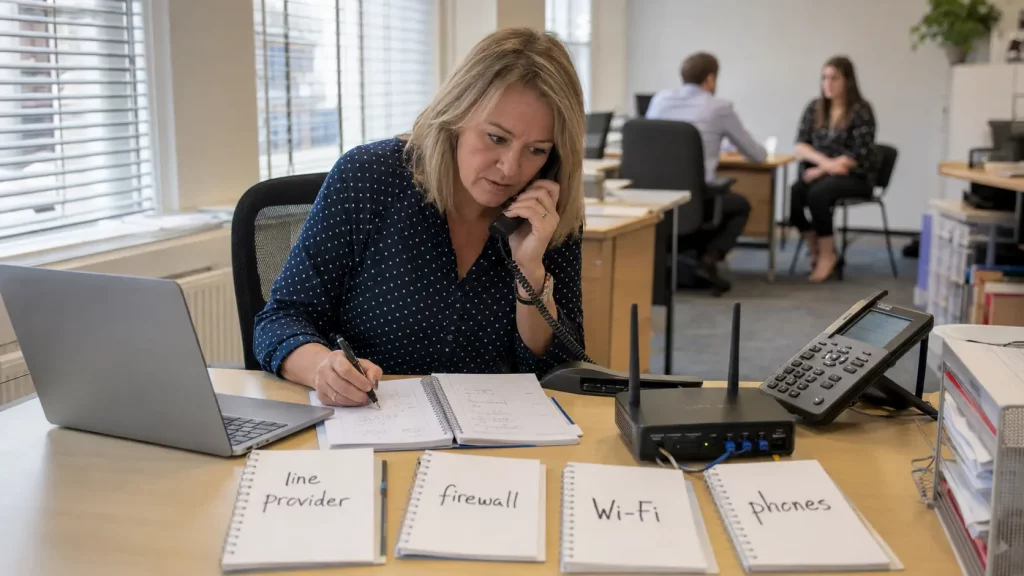
For many SMEs, the uncomfortable answer is that responsibility is split. One provider supplies the internet connection. Another looks after the firewall. Another installed the Wi-Fi. Someone else handles hosted voice. A local server, remote access route or backup connectivity option may sit in yet another corner. Each supplier may be doing its own job, but the business still lacks one clear view of the environment.
Table of Contents
Why this is more than a cyber awareness issue
The NCSC gives small and medium-sized organisations practical guidance on cyber security, and its Cyber Action Toolkit is designed to help smaller organisations take action without needing to become technical experts. That advice matters. Staff awareness, account protection and basic cyber hygiene are all important.
But SME resilience also depends on the infrastructure underneath daily work. Email, cloud systems, payments, remote access, phones, Wi-Fi, servers and customer service all rely on networks and managed technology being visible, maintained and understood.
A phishing email may be the visible event. The business disruption often comes from everything around it: unclear access, slow escalation, supplier handoffs, missing monitoring, incomplete asset knowledge or a firewall change nobody can explain quickly.
That is where fragmented IT becomes a commercial risk. It creates delay at the exact moment when speed and clarity matter.
The hidden cost of fragmented responsibility
Fragmented technology rarely feels dangerous during a normal week. The internet works. Calls connect. Staff can log in. The Wi-Fi seems stable enough. Suppliers answer their own support queues.
The gaps usually appear during pressure:
- a suspicious login or access change needs investigation;
- a firewall rule affects remote users;
- hosted phones behave badly after a connectivity issue;
- a site loses service and nobody knows whether the line, router, firewall or internal network is at fault;
- performance drops and each supplier says its part looks fine;
- a renewal arrives and the business cannot easily tell what is business critical.
The cost is not only technical downtime. It is management time, customer disruption, delayed decisions and the familiar frustration of being passed between suppliers.
The practical SME question is not, “Do we have suppliers?” It is, “Can anyone see the whole picture?”
Five ownership checks for UK SMEs
1. Who can see the whole environment?
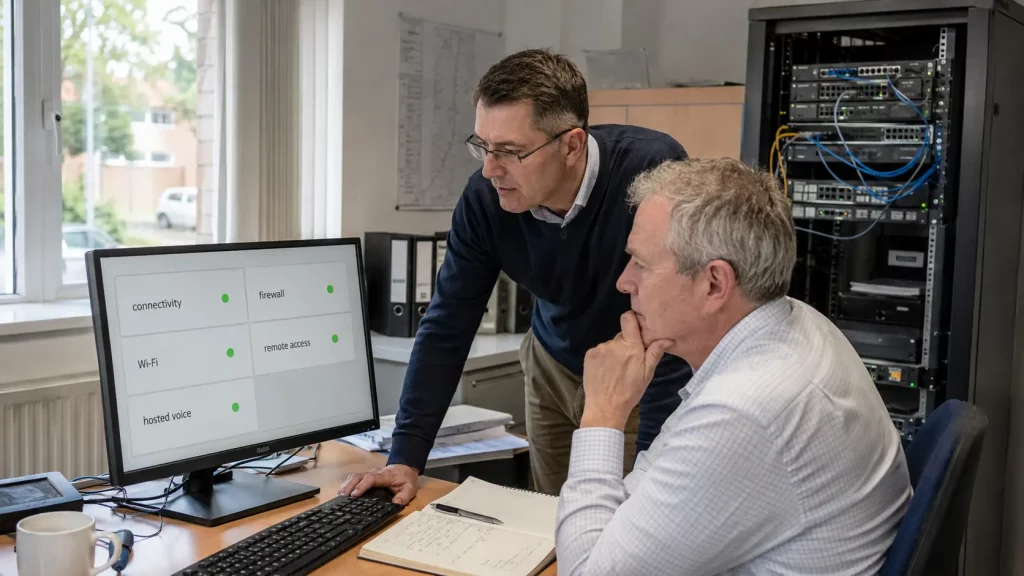
If each supplier can only see its own part, your business may still be blind to the way systems interact. Connectivity, firewall rules, Wi-Fi, remote access, hosted voice and servers do not fail in neat supplier boxes. They depend on each other.
A useful ownership review should map the core infrastructure and show who can see each dependency.
2. Who monitors issues before users complain?
Many SMEs still run on reactive signals. If staff are not complaining, the assumption is that everything is fine. That is risky when performance, access or security issues can build quietly before they become obvious.
Monitoring gives the business a better early-warning system. It does not guarantee that issues disappear, but it helps replace guesswork with visibility.
3. Who owns firewall and remote access changes?
Remote access is now part of normal business operations. Firewall management sits close to that access. Small changes can affect security, performance and user access if they are made without full context.
SMEs should know who approves changes, who documents them, who checks the impact and who can reverse a change if it causes a problem.
4. Who coordinates suppliers when the answer is not obvious?
A breach concern, performance problem or outage may not sit neatly with one supplier. It may involve the line, router, firewall, Wi-Fi, server or hosted voice service.
If the business owner has to translate technical updates between several suppliers, ownership is already too fragmented. Clear accountability means someone is responsible for joining the dots.
5. What happens when a critical connection or service fails?
Ofcom’s resilience work is aimed at communications providers, but the business lesson is wider: reliance on digital services makes resilience planning more important. SMEs should know which services are critical, what depends on internet access, and whether any backup connectivity or failover is configured.
The key phrase is “where configured”. Resilience is not automatic. It has to be designed, checked and maintained.
What clearer ownership looks like
Clearer ownership does not mean pretending that one service can solve every cyber or IT problem. It means the infrastructure foundation has a visible owner, practical monitoring and a clear escalation route.
- one team with visibility across networking, security, Wi-Fi and infrastructure;
- 24/7 Network Operations Centre monitoring;
- firewall and remote access management handled with full context;
- proactive issue detection and maintenance;
- performance data that helps renewal and upgrade decisions;
- fewer situations where the customer has to sit between suppliers;
- backup connectivity failover considered where the business case supports it.
This is where 1Connect’s Sentinel service fits.
Sentinel is built around managed infrastructure, networking, security, Wi-Fi, servers, monitoring, firewall management, remote access, edge compute and virtualisation. The value is not just the component list. It is the joined-up responsibility around the infrastructure that the business depends on.

A useful next step
Start with a simple ownership map:
- internet connectivity;
- firewall and security settings;
- Wi-Fi;
- servers or local systems;
- remote access;
- hosted voice or communications;
- monitoring;
- backup or failover routes where configured.
Next to each area, write down who supplies it, who monitors it, who can make changes and who owns the answer when something crosses supplier boundaries.
If that map is unclear, duplicated or full of assumptions, it is worth reviewing before the next breach concern, outage or renewal forces the issue.
1Connect can help you review where responsibility, monitoring and resilience currently sit across your infrastructure, and whether Sentinel could give your business a clearer managed route forward.