Full Fibre for Business: 6 Essential Questions UK Companies Should Ask Before 2027
Ofcom published its Telecoms Access Review 2026–31 in March 2026, setting out how it will regulate the UK’s wholesale broadband markets through to March 2031. The rules took effect on 1 April 2026.
For telecoms providers and network operators, the review is a significant piece of regulatory machinery. For most business owners, it will pass without notice. Full fibre for business may still feel like an abstract infrastructure matter rather than something that affects daily operations. But there is one practical implication worth paying attention to: the UK’s connectivity landscape is changing faster than many businesses have registered, and Ofcom’s new framework is a signal that the direction of travel is not reversing.
The UK fibre market has moved on, and business assumptions should too
Full fibre availability has grown dramatically since Ofcom’s last review in 2021, with nearly eight in ten homes now having access, up from less than a quarter at the start of the review period. Full fibre is now available to around 69% of UK premises, with gigabit-capable broadband reaching 83%. Ofcom projects that coverage could reach 96% of premises by 2027 if network deployments continue at pace.
That is a substantial shift in a short period. The regulatory direction is equally clear: Ofcom is progressively shifting regulation away from copper services to full fibre services, giving Openreach flexibility to encourage customers to migrate off its old copper network.
For businesses, this matters because the underlying infrastructure that connectivity services are built on is changing. Assumptions made about broadband availability, service quality, or value for money a few years ago may no longer reflect what is actually available or sensible today.
Why this matters to businesses, not just telecoms providers
Many businesses treat internet connectivity as a background utility. It gets renewed at the end of a contract without much thought, provided it broadly works. That approach made reasonable sense when relatively few business systems depended on a stable connection.
It makes less sense now. Cloud software, hosted phone systems, video calls, remote access, payment processing, file storage, and customer communications have all moved online in ways that have quietly made connectivity a central operational dependency rather than a secondary one.
The question for most businesses is no longer simply whether they can get online. It is whether their current connection reliably supports the way the business actually runs today: the call volumes, the cloud tools, the number of people using it simultaneously, the cost of a bad day.
Full fibre for business: availability is not the same as suitability
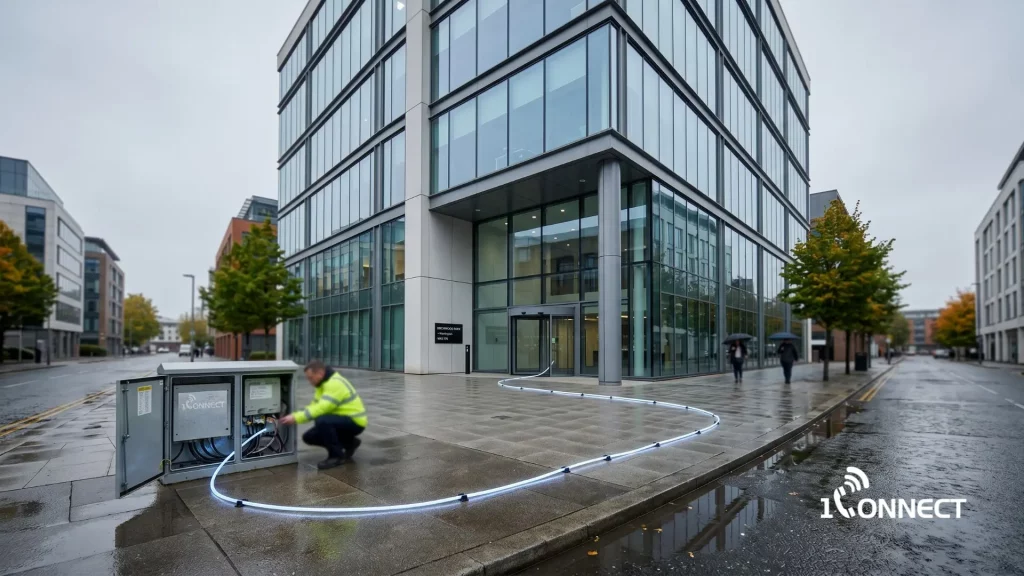
Full fibre is a fibre-optic connection delivered directly to the premises, rather than partly over older copper lines. It generally offers faster speeds, more consistent performance, and better future-readiness. But availability is not the same as suitability.
Businesses need to think beyond whether fibre is available at their address and ask whether the service they are considering genuinely fits their day-to-day demands. Factors like usage patterns, number of concurrent users, cloud and voice traffic, uptime expectations, and what support looks like when something goes wrong all matter as much as the headline speed.
A fibre connection that handles fifty users, continuous video calls, and a cloud-hosted phone system has different requirements to one supporting a small office with occasional email and browsing. Both may be served by broadly the same product category. Whether they are well served is a different question.
When it is worth asking whether standard broadband is still enough
For many businesses, standard broadband remains entirely adequate. The point is not to suggest otherwise.
But for businesses with multiple sites, heavy reliance on cloud software, significant voice or video traffic, customer-facing phone dependency, regular large file transfers, or low tolerance for downtime, the standard package may no longer be the best fit. The relevant issue is not purely headline download speed. It is reliability, predictable performance under load, how quickly problems are resolved, and how much disruption the business can absorb.
These are worth reviewing periodically. Not because something has necessarily gone wrong, but because the business may have changed significantly since the current connection was set up. Hybrid working, increased cloud dependence, and new software tools can quietly shift the requirements without anyone formally reassessing the infrastructure that supports them.
Where leased lines fit naturally into the conversation
A leased line is a dedicated internet connection for a single business site, rather than a service shared across multiple customers on the same local infrastructure. It is typically chosen by businesses that need stronger reliability, more consistent performance, and clearly defined service expectations.
Ofcom’s new framework continues to regulate leased line services based on competition levels across different parts of the UK, reflecting the varying maturity of these markets. In practice, that means leased line availability and pricing varies by location, and that is worth checking rather than assuming.
A leased line tends to make most commercial sense where connectivity problems would carry a real operational cost: businesses with busy cloud systems, high call volumes, multiple locations, or limited tolerance for slowdowns and outages. It is not the right answer for every business, but for those where reliability genuinely matters, it is worth at least understanding what the options look like.
Why reviewing connectivity now is the sensible move
Ofcom’s framework reflects a market that is moving decisively towards full fibre and away from older copper-based assumptions. That makes 2026 a reasonable moment for businesses to review their connectivity position calmly, before a contract renewal forces the issue, before a service problem makes it urgent, or before the business grows into a setup that its current connection cannot support.
A review does not necessarily mean switching provider or spending more. It means understanding what the business now depends on, what level of resilience is appropriate, and whether the current setup still fits. Or whether the quiet shift in how the business operates has outpaced the infrastructure supporting it.
Practical questions worth asking now
If you are responsible for keeping the business running, these are worth working through:
- How many daily operations now depend on a stable internet connection?
- What would the practical impact be if the connection failed for half a day?
- Have our phone systems, cloud tools, or remote access requirements grown significantly in the last two years?
- Is full fibre now available at our premises where it was not before?
- Do we need more resilience, faster support response, or more predictable performance than we currently have?
- Would a leased line, a backup connection, or a more managed setup reduce meaningful operational risk?
If you are not sure where to start, 1Connect offers a free business connectivity check. Enter your postcode and get an instant price and availability report in under 30 seconds, with no commitment required.
The sensible takeaway
The main point is not that every business should upgrade immediately. It is that the UK connectivity landscape has changed substantially, and business assumptions should have kept pace.
Ofcom’s new rules reflect a market in the final phase of its transition to full fibre for business and beyond, with the regulator progressively moving focus away from legacy copper infrastructure. For businesses still running on an assumption that their broadband is probably fine, this is a reasonable prompt to actually check.
For some, current broadband will remain the right answer. For others, this may be the point where a more reliable or resilient setup starts to make clear commercial sense.
Wondering whether your current connection still fits how the business works today? Start with a free business connectivity check. Enter your postcode and get an instant availability and price report in under 30 seconds. No commitment, no sales call unless you want one. Or if you’d prefer to talk it through, get in touch and we’ll take it from there.
Sources: Ofcom, Telecoms Access Review 2026–31; Ofcom, Connected Nations data; techUK, TAR 2026–31 analysis.