Managed infrastructure accountability matters because most growing UK businesses do not have one broken piece of technology. They have a working firewall from one supplier, a separate broadband contract, Wi-Fi that was installed by a third company, servers that someone else maintains on a break-fix basis, and a handful of users who just want things to work. When a problem appears, and it always does, the real issue is not usually the firewall or the Wi-Fi or the server. It is the gap between them.
Nobody owns the whole picture.
That gap has a name in operational IT circles: the blame gap. And it costs SMEs more than most directors realise, not just in downtime, but in recurrence, lost visibility and the slow drain on leadership attention that nobody budgets for.
Table of Contents
What the IT blame gap really costs your business
The blame gap is easiest to describe through the kind of week that becomes normal without anyone deciding it should be.
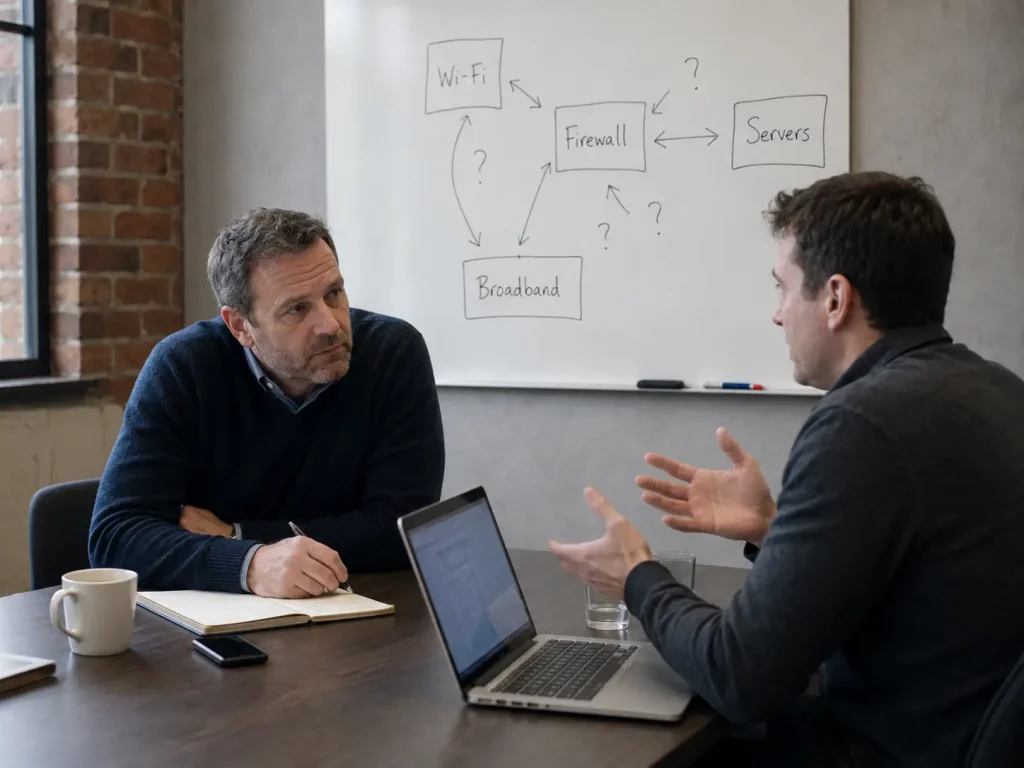
Monday morning, remote staff cannot connect reliably. Your internet provider confirms the line is fine. The firewall support partner says the VPN configuration is standard. The company that supplied the access points says the Wi-Fi survey was correct. Each party is right about their own piece, but nobody is accountable for whether the pieces work together. Your operations manager spends the morning translating between suppliers instead of doing their actual job.
This is not a one-off. Businesses operating with fragmented infrastructure responsibility see the same patterns repeat. A network slowdown triggers the same round of calls. A security concern surfaces and three different suppliers need to be brought up to speed before anyone can assess the risk. An audit or compliance review asks a straightforward question about infrastructure ownership, and the answer involves emailing four separate organisations.
The costs break down into four areas that businesses rarely track together:
Time. Every incident that crosses supplier boundaries consumes internal hours that should be spent on revenue-generating work. Someone has to diagnose, coordinate, translate and chase. In a business with 30 to 200 staff, that someone is often a director or senior manager whose time is expensive in more ways than one.
Recurrence. When nobody owns the root cause, the same issues come back. A fix applied to one component does not address the interaction between components. Three months later, the same symptoms reappear because the underlying gap was never closed.
Visibility. Fragmented infrastructure means fragmented reporting. No single dashboard tells you what is happening across your network, security posture and server health right now. Decisions get made on partial information because nobody has the whole picture to share.
Leadership distraction. This is the cost that rarely appears on a spreadsheet. Every hour a director spends on infrastructure triage is an hour not spent on customers, strategy, growth or team development. Over a year, the distraction compounds.
Why growing SMEs outgrow fragmented infrastructure arrangements
There is a natural point in a growing business where the informal IT setup stops working. It is not a sudden failure. It is a gradual accumulation of friction that the leadership team starts to feel but struggles to name.
In the early days, a business might have a single broadband line, a consumer-grade router, a few laptops and someone reasonably technical who sorts things out when they break. As the business grows, the picture fragments. You add a proper firewall. You upgrade the Wi-Fi. You move servers to a colocation facility or a cloud instance. You introduce remote access. Each addition often comes from a different supplier, selected at the time because they were the right fit for that specific need.
The result is an infrastructure estate that nobody designed end to end. It grew. And because it grew, nobody owns the relationships between its parts.
This is not a criticism of how UK SMEs manage technology. It is a description of what happens when operational needs outpace the governance structure around them. The NCSC’s guidance for small and medium-sized organisations consistently advises businesses to plan before incidents happen, to understand their infrastructure dependencies and to have clear ownership of security and resilience. That is hard to do when the dependencies cross four different supplier relationships and the ownership question has no single answer.
The GOV.UK Cyber Security Breaches Survey 2025/2026 reports that 43% of UK businesses identified a cyber breach or attack in the previous 12 months. While this statistic should not be used to overstate individual risk, it does underline a broader point: infrastructure security is not a standalone product you buy. It is a property of how your infrastructure is managed, monitored and owned day to day.

What managed infrastructure accountability looks like
The alternative to fragmented responsibility is not buying more products or finding a single piece of software that solves everything. It is changing the accountability model.
Managed infrastructure accountability means that one team, under one commercial relationship, is responsible for making sure your network, security, Wi-Fi, servers, firewall, remote access and monitoring work as a coherent whole. That team runs a 24/7 operations function, so issues are detected and addressed before users notice them. They maintain visibility across the entire infrastructure layer, so when a question needs answering, the answer comes from one source, not four.
For UK SMEs, this model typically includes:
- A single point of contact for infrastructure issues, changes and planning. No more translating between suppliers.
- Proactive monitoring that catches problems during the night, not during the working day.
- Security built into the infrastructure layer, not added as a separate project after everything else is in place.
- Regular visibility reporting that gives directors and operations managers a clear picture of infrastructure health without needing technical depth.
- On-site support from people who understand the whole environment, not just one product within it.
The commercial logic is straightforward: one accountable relationship replaces multiple transactional ones. The operational logic is even simpler: when something needs attention, one team owns the response.
Where 1Connect can safely help
1Connect cannot claim to eliminate every infrastructure problem a growing business will ever face. No provider can, and any provider that says otherwise should be treated with caution.
What 1Connect can do is help businesses move from fragmented supplier coordination to a managed infrastructure conversation where one team owns the accountability.
Sentinel, 1Connect’s managed infrastructure platform, is designed for exactly this situation. It brings together networking, security, Wi-Fi, servers, monitoring, firewall management, remote access, backup and recovery options, and edge compute or virtualisation under one managed environment. Behind it sits a UK-based Network Operations Centre providing 24/7 proactive monitoring. Security is part of the infrastructure design, not an afterthought layered on top. Visibility replaces guesswork.
For a business currently managing infrastructure across three or four separate relationships, the practical starting point is not a technical migration. It is a conversation.

A practical check you can run this week
Before you speak to any provider, ask yourself three questions about your current setup:
- If a network issue affects both remote access and on-site systems right now, do you know which single person or team owns the diagnosis and resolution?
- When was the last time you saw a single report covering the health of your firewall, network, servers and Wi-Fi in one place?
- How many hours did your leadership team spend on infrastructure-related issues last month, and do you know what that time cost the business?
If the answers to those questions are uncomfortable, the infrastructure accountability gap is already costing you. The good news is that changing the model is more straightforward than most businesses expect.
Talk to 1Connect about moving from fragmented infrastructure responsibility to a managed infrastructure conversation. Ask whether Sentinel is a fit for your business. The first conversation is about understanding what you have now, where the gaps sit and whether a single accountable team would change the picture. There is no obligation, and no one will try to sell you a product that does not match your actual situation.
Sources and further reading
- 1Connect Sentinel: managed infrastructure, edge compute and networking platform.
- NCSC: Small and medium-sized organisations guidance on cyber resilience and incident planning.
- GOV.UK: Cyber Security Breaches Survey 2025/2026.